Piaget Learning Concept: Stages Of Cognitive Development
by TeachThought Staff
Jean Piaget (1896 – 1980 was a Swiss psychologist and among the most influential figures in developing psychology.
Piaget is best known for his introducing work on the cognitive growth of youngsters. His study reinvented our understanding of just how youngsters find out and expand intellectually. He recommended that kids actively create their understanding through stages, each identified by distinct ways of assuming and recognizing the world.
His concept, ‘Piaget’s phases of cognitive growth,’ has profoundly affected formal education, stressing the importance of customizing mentor approaches to a youngster’s cognitive developmental phase rather than anticipating all children to discover in a similar way.
Jean Piaget’s concept of cognitive advancement describes a collection of developmental phases that kids advance with as they grow and mature. This theory suggests that youngsters proactively construct their understanding of the world and distinct cognitive capabilities and means of believing identify these phases. The four main stages are the sensorimotor phase (birth to 2 years), the preoperational stage (2 to 7 years), the concrete operational stage (7 to 11 years), and the official functional phase (11 years and past).
See additionally Degrees Of Combination Of Crucial Thinking
A Quick Summary Of Piaget’s Phases Of Cognitive Advancement
In the sensorimotor phase, babies and young children discover the globe with their senses and activities, slowly developing object permanence. The preoperational stage is noted by the appearance of symbolic thought and using language, although abstract thought is limited. The concrete functional stage sees children begin to assume even more rationally about concrete occasions and objects.
Finally, in the official functional stage, adolescents and grownups can believe abstractly and hypothetically, allowing for a lot more complicated analytic and thinking. Piaget’s concept has influenced mentor methods that align with students’ cognitive advancement at various ages and stages of intellectual growth.
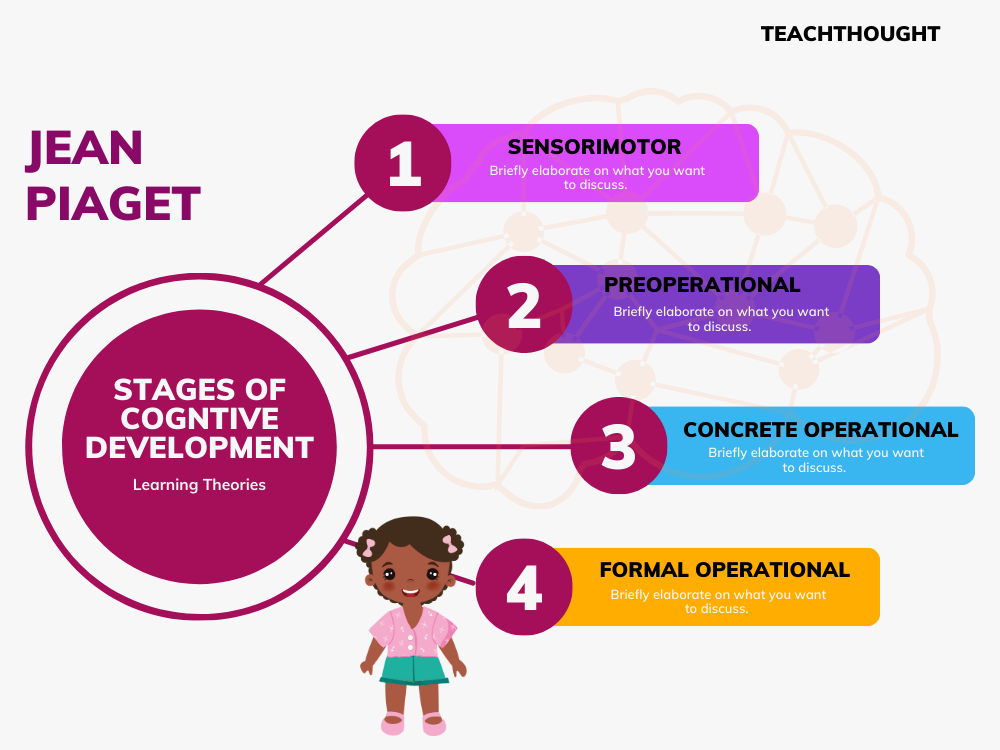
Piaget’s Four Phases Of Cognitive Growth
Piaget’s Stage 1: Sensorimotor
Piaget’s sensorimotor phase is the first developing stage, typically occurring from birth to around two years old, during which babies and kids mainly discover the world with their detects and physical actions.
Secret features of this phase consist of the advancement of item durability, the understanding that things continue to exist also when they are not visible, and the gradual formation of easy mental depictions. At first, infants engage in reflexive actions, yet as they progress via this stage, they start to purposefully coordinate their sensory understandings and motor abilities, exploring and controling their setting. This stage is noted by considerable cognitive growth as children shift from purely second-nature reactions to much more purposeful and collaborated communications with their environments.
One instance of Piaget’s sensorimotor phase is when a child plays peek-a-boo with a caretaker. In the very early months, a baby lacks a sense of item permanence. When an object, like the caregiver’s face, disappears from their view, they might act as if it no longer exists. So, when the caretaker covers their face with their hands during a peek-a-boo video game, the baby might react with shock or light distress.
As the baby advances through the sensorimotor phase, generally around 8 to 12 months, they begin to establish things durability. When the caretaker conceals their face, the infant comprehends that the caretaker’s face still exists, although it’s briefly hidden. The infant may react with anticipation and excitement when the caretaker discovers their face, demonstrating their advancing ability to form psychological representations and grasp the principle of item permanence.
This progression in understanding is an essential attribute of the sensorimotor phase in Piaget’s theory of cognitive growth.
Piaget’s Stage 2: Preoperational
Piaget’s preoperational phase is the second phase of cognitive development, usually occurring from around 2 to 7 years of age, where youngsters start to establish symbolic reasoning and language skills. During this stage, kids can stand for things and concepts making use of words, images, and signs, enabling them to engage in pretend play and interact more effectively.
However, their thinking is identified by egocentrism, where they struggle to take into consideration other people’s point of views, and they display animistic thinking, connecting human top qualities to inanimate items. They also lack the ability for concrete reasoning and have problem with tasks that require understanding preservation, such as acknowledging that the quantity of a liquid continues to be the very same when poured right into various containers.
The Preoperational phase stands for a considerable shift in cognitive development as children shift from fundamental sensorimotor reactions to advanced symbolic and representational thought.
One instance of Piaget’s preoperational phase is a kid’s understanding of ‘preservation.’
Visualize you have 2 glasses, one high and slim and the various other brief and large. You pour the same quantity of liquid right into both glasses to consist of the exact same volume of liquid. A kid in the preoperational phase, when asked whether the quantity of fluid coincides in both glasses, could claim that the taller glass has more fluid since it looks taller. This demonstrates the kid’s failure to understand the principle of preservation, which is the idea that also if the look of a things modifications (in this case, the shape of the glass), the quantity continues to be the very same.
In the preoperational phase, youngsters are commonly focused on the most famous affective aspects of a situation and struggle with even more abstract or logical thinking, making it difficult for them to realize preservation concepts.
Piaget’s Stage 3: Concrete Operational
Piaget’s Concrete Operational phase is the third phase of cognitive development, typically occurring from around 7 to 11 years of age, where children show boosted abstract thought and analytical capabilities, particularly in relation to concrete, tangible experiences.
During this stage, they can recognize concepts such as conservation (e.g., identifying that the quantity of liquid stays the exact same when put right into different containers), and reversibility (e.g., recognizing that an activity can be undone). They can carry out standard psychological operations like addition and reduction. They become extra with the ability of thinking about different perspectives, are less egocentric, and can participate in even more organized and orderly thought processes. Yet, they might still battle with abstract or hypothetical thinking, a skill that arises in the subsequent official functional phase.
Envision 2 the same containers full of the same quantity of water. You put the water from one of the containers right into a taller, narrower glass and pour the water from the various other right into a much shorter, wider glass. A kid in the concrete functional phase would certainly have the ability to acknowledge that both glasses still have the very same quantity of water regardless of their different shapes. Kids can understand that the physical look of the containers (tall and narrow vs. short and large) doesn’t transform the amount of the liquid.
This capacity to understand the idea of preservation is a hallmark of concrete operational reasoning, as youngsters come to be a lot more experienced at logical idea pertaining to real, concrete scenarios.
Phase 4: The Official Functional Phase
Piaget’s Formal Operational stage is the fourth and final stage of cognitive development, usually emerging around 11 years and proceeding into the adult years. Throughout this phase, people get the ability for abstract and theoretical thinking. They can address complex problems, think critically, and factor about concepts and ideas unassociated to concrete experiences. They can engage in deductive reasoning, considering numerous possibilities and prospective outcomes.
This phase enables advanced cognitive capabilities like understanding scientific principles, preparing for the future, and pondering ethical and moral dilemmas. It stands for a substantial change from concrete to abstract thinking, allowing individuals to check out and recognize the world a lot more thoroughly and imaginatively.
An Instance Of The Formal Operation Phase
One example of Piaget’s Formal Operational phase includes a teenager’s capacity to believe abstractly and hypothetically.
Imagine presenting a teenager with a traditional moral problem, such as the ‘trolley issue.’ In this scenario, they are asked to think about whether it’s ethically appropriate to draw a lever to draw away a cart far from a track where it would hit 5 people, however in doing so, it would then strike a single person on another track. A young adult in the formal functional phase can engage in abstract ethical reasoning, considering numerous honest concepts and potential repercussions, without depending entirely on concrete, personal experiences.
They might ponder utilitarianism, deontology, or various other moral structures, and they can think of the theoretical end results of their choices.
This abstract and hypothetical thinking is a characteristic of the formal functional phase, demonstrating the ability to factor and review facility, non-concrete issues.
Exactly How Educators Can Use Piaget’s Stages Of Development in The Class
1 Private Differences
Comprehend that children in a class may be at different phases of advancement. Tailor your training to accommodate these distinctions. Offer a range of activities and methods to deal with different cognitive degrees.
2 Constructivism
Acknowledge that Piaget’s concept is rooted in constructivism, suggesting youngsters proactively construct their understanding with experiences. Motivate hands-on discovering and exploration, as this straightens with Piaget’s emphasis on finding out through communication with the atmosphere.
3 Scaffolding
Be prepared to scaffold guideline. Trainees in the earlier stages (sensorimotor and preoperational) might need more advice and support. As they proceed to concrete and official operational phases, progressively boost the intricacy of jobs and give them extra freedom.
4 Concrete Examples
Trainees gain from concrete instances and real-world applications in the concrete functional phase. Usage concrete materials and functional troubles to help them understand abstract concepts.
5 Energetic Discovering
Advertise active understanding. Motivate trainees to assume critically, fix issues, and make connections. Usage flexible questions and urge conversations that assist students move from concrete thinking to abstract reasoning in the formal operational stage.
6 Developmentally Suitable Curriculum
Ensure that your curriculum straightens with the pupils’ cognitive capacities. Introduce abstract concepts gradually and link new finding out to previous expertise.
7 Regard for Distinctions
Hold your horses and respectful of individual differences in advancement. Some trainees might comprehend concepts previously or behind others, and that’s completely regular.
8 Assessment
Establish analysis strategies that match the students’ developing phases. Examine their understanding using techniques that are suitable to their cognitive capacities.
9 Specialist Development
Educators can remain upgraded on the most recent kid growth and education study by attending professional development workshops and teaming up with colleagues to continually refine their training methods.